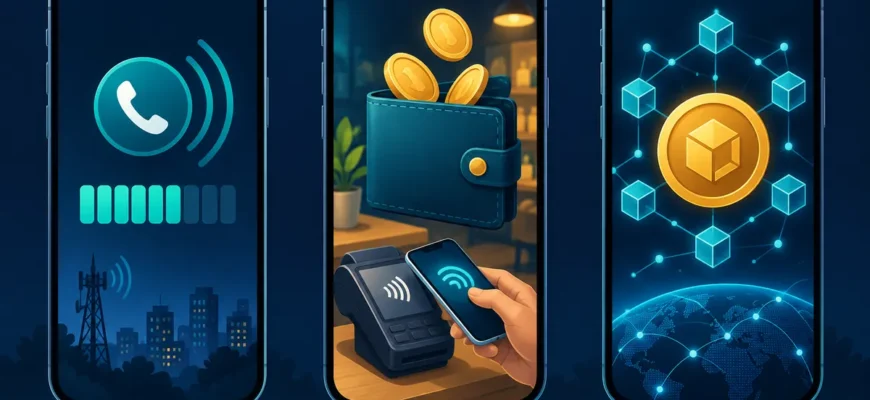
A balance displayed on a phone can represent very different things. It might let someone make calls, pay a merchant or hold a crypto-asset. Yet words such as “credit,” “balance” and “wallet” are often used without explaining what the recipient will actually be able to do with the value received.
When choosing how to support someone remotely or make a payment, fees and speed are therefore only part of the picture. You need to identify what will be delivered, where it can be used and under what conditions it can be transferred or converted. Phone credit, mobile money and stablecoins meet different needs, even when they are accessible from the same device.
Phone credit: paying remotely does not mean transferring money
A mobile top-up adds credit to a number for an operator’s services, subject to the offer’s terms: calls, texts or data use, for example. The buyer’s payment and the credit received are two different things. Spending money to recharge a relative’s phone does not mean placing that amount in a wallet they can use freely.
For international phone top-ups—also called recharges mobiles in French—a service such as Numio lets the sender begin by choosing the destination country and entering the recipient’s number. This serves a specific purpose: adding credit to a supported mobile number. It should not be confused with opening or funding a payment account.
The process outlined at https://www.numio-mobile.com/how-it-works explains the sequence: choose the country, enter the number, select an amount and pay, after which the top-up is submitted to the operator once payment is confirmed. Numio says it automatically identifies the supported operator. The final amount may be rounded down to the nearest value that operator accepts, so the amount initially requested is not necessarily the final top-up amount.
Delivery of the credit must also be distinguished from its possible uses. Any transfer of airtime between subscribers, conversion into a bundle or other option depends on the operator’s rules. Never assume that phone credit can be withdrawn as cash. If the recipient needs to buy groceries rather than make calls, a top-up alone may not meet their needs.
Mobile money: a payment balance whose uses depend on the service
Mobile money relies on an account accessible through a phone, separate from the credit consumed for telecommunications. Depending on the service and local framework, that account may allow users to store monetary value, transfer funds, pay merchants or settle bills. The phone is a way to access the account; it does not determine the legal nature of the balance.
The GSMA’s Mobile Money Glossary distinguishes these operations. Cash-in means depositing cash in exchange for credit in the mobile money account; cash-out is the reverse operation, with cash handed to the customer. The glossary also describes transfers, payments and the agents who make these services accessible.
This distinction has a practical consequence: having a balance and being able to obtain banknotes immediately are not the same thing. Withdrawal must be permitted, a service point must be accessible and the agent must have enough cash available. Limits, fees, identification requirements and account conditions may also restrict the transaction.
The same operator may offer telecommunications and mobile money under similar branding. That does not make their balances interchangeable. Before sending value, ask which account the recipient uses and what they need it for. A phone number may serve as an identifier, but it does not prove that a wallet is activated or can receive a particular transfer.
It would also be misleading to treat every mobile money account as a bank deposit. The service’s legal classification, safeguarding rules and available remedies depend on the country and provider. For a substantial amount, these conditions deserve as much attention as the advertised fee.
Stablecoins: a target value does not guarantee universal acceptance or redemption
A stablecoin is a crypto-asset designed to target a relatively stable value by reference to an asset or a group of assets. That reference may be a currency, but the word “stable” is not a price guarantee. The mechanism used, the quality of any reserves, redemption conditions and market liquidity need to be examined separately.
The European supervisory authorities’ factsheet Crypto-assets explained: What MiCA means for you as a consumer presents crypto-asset categories and protections associated with the MiCA regulation. It notes that the intended stability may not be maintained, particularly during periods of stress. Holders’ rights vary with the type of asset, the service used and the provider’s status.
Holding a token that targets a value of one euro therefore does not mean being able to pay everywhere as though it were a euro in a payment account. The merchant must accept that asset, either directly or through an intermediary. To obtain cash or a bank transfer, the recipient generally needs an accessible conversion route, with its own fees, checks and processing times.
It is also important to separate selling on a market from redemption with an issuer. The former depends partly on the available price and liquidity. The latter depends on the rights attached to the token and the applicable conditions. Assuming that every stablecoin provides the same redemption options can lead to unpleasant surprises.
A self-custody wallet also requires users to protect their keys and check transactions before signing them. A custodial service shifts some responsibility to an intermediary without eliminating access, fraud or failure risks. For someone who simply needs phone credit, these steps may add unnecessary complexity.
Countries, operators and blockchains: why coverage does not prove compatibility
Broad geographical coverage does not guarantee that every transaction will be possible. For a top-up, the country, operator, number and available amounts must be compatible. Numio advertises more than 130 countries and over 600 operators, but specifies that available operators and options depend on the chosen destination. A coverage claim is therefore a starting point, not confirmation that a particular number is supported.
For mobile money, two wallets may operate in the same country without supporting every transfer between them. Check the receiving service, any arrangements between networks and the conditions for an international transfer. Cash withdrawal depends on additional factors: agent locations, opening hours, limits and cash availability.
Stablecoin compatibility introduces another technical layer. An asset with the same name may circulate on several blockchains, without the receiving platform accepting all of them. A correctly copied address is therefore not enough: the network, exact token and any required additional identifier must match the recipient’s instructions.
Bridges between networks and conversions can address some incompatibilities, but they add costs and risks. They should not be improvised after sending. Checks need to cover the entire journey, from the sender’s payment to the recipient’s final use, rather than just whether an app is available.
Speed deserves the same caution. Payment confirmation, delivery of phone credit, recording a transaction on a blockchain and cash availability are different events. One fast stage does not prove that the recipient can immediately use the value in the way they intended.
Checks to make before sending digital value
Start by describing the need without naming a technology: enabling calls, paying a bill, providing cash or transferring a digital asset. This helps avoid choosing a tool simply because the sender is familiar with it. The best route is one the recipient can actually use.
- Identify the balance received: telecommunications credit, a payment balance or a crypto-asset, together with its permitted uses.
- Confirm the destination: country and number for a top-up, an activated account for mobile money, or the address and network for a stablecoin.
- Compare the net result: the amount delivered, any exchange rate and payment, network, conversion or withdrawal fees along the route.
- Check the exit options: can the recipient pay the intended merchant, withdraw cash or obtain redemption or a refund, and under what conditions?
- Prepare for tracking: keep the reference, status and support contact details without disclosing sensitive information.
Reversibility must be checked before confirmation. Numio warns that a top-up submitted to the operator may no longer be reversible and asks users to verify the country, number and amount. For a payment wallet, remedies depend on the service and circumstances. For a blockchain transaction, do not count on cancellation comparable to stopping an instruction that is still pending with an intermediary.
If a transaction remains uncertain, check its status before repeating it: a second attempt could create a duplicate. If a request seems unusual, confirm the relative’s identity through an established contact channel. No legitimate support team needs your crypto recovery phrase to investigate a transaction.
These three forms of value are neither equivalent nor inherently ranked. Phone credit serves telecommunications needs; mobile money enables payment operations according to its network and rules; a stablecoin adds the possibilities and constraints of a crypto-asset. Choosing well means matching the balance sent to the real need, the recipient’s capabilities and the rights actually available.